
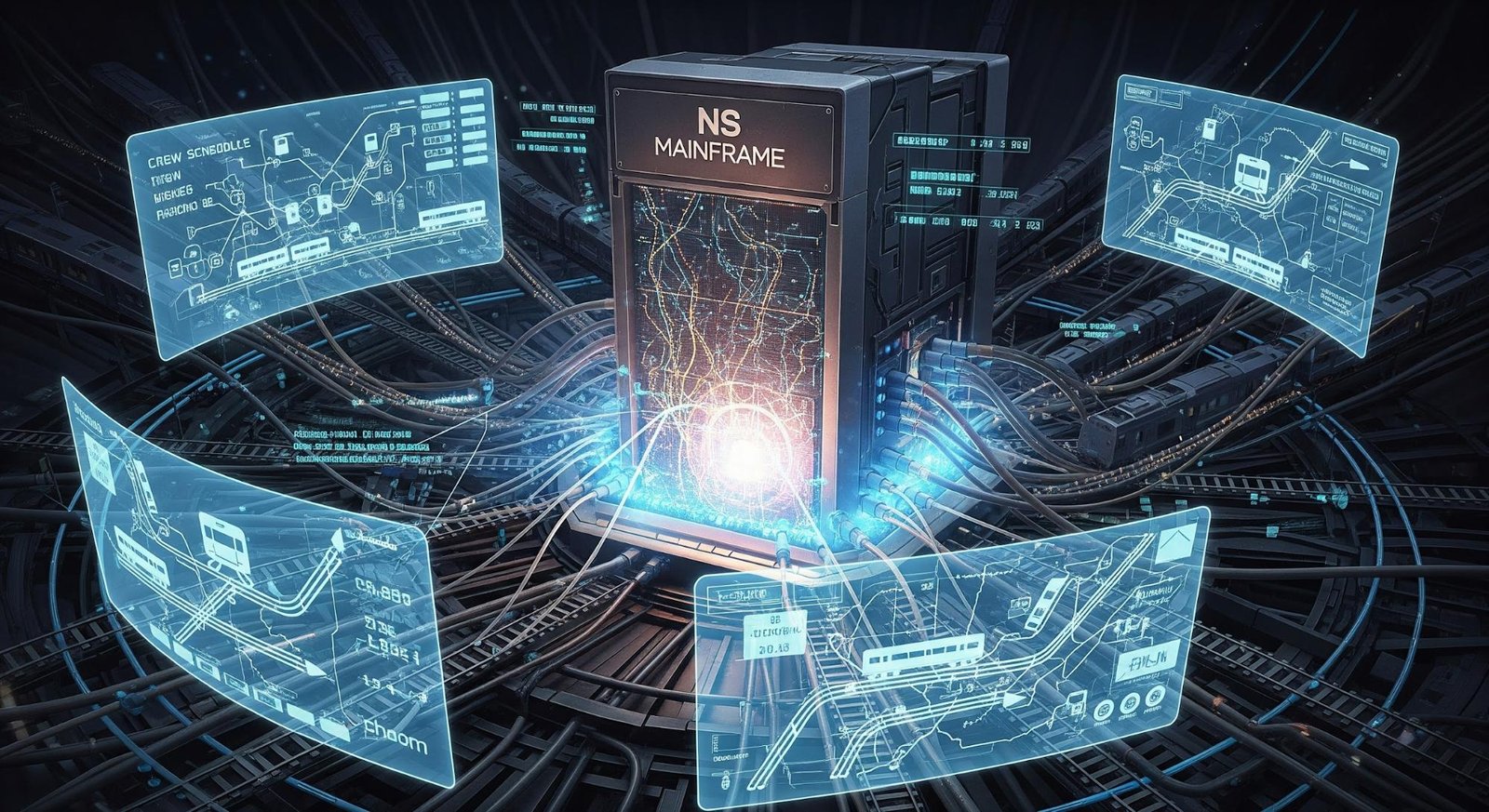
Have you ever stood at a railway platform and caught yourself wondering, “How does all of this actually work?”
Like seriously—hundreds of trains, thousands of people, signals flashing like Christmas lights, crew members rushing around like it’s a movie set… but somehow the whole system mostly works.
I had this moment once, at some random station in the middle of nowhere. The weather was weird, the train ahead was delayed, the announcements felt confused… and yet, my own train rolled in basically on time. Not perfect. But close.
And it hit me:
There is no way this happens without a giant, invisible machine making decisions faster than humans ever could.
That’s where the NS Mainframe steps in.
Not the “cute little server room” type tech—no.
This thing is like the heavyweight champion of transportation computers. The type that doesn’t sleep, doesn’t complain, and doesn’t get confused even when everything around it is falling apart.
Let’s dig deeper, but gently. No geeky jargon jumpscares.
Just the real picture.
What NS Mainframe Actually Is (Explained Like a Real Person Would)
Okay, picture this:
Take the most complicated train map you’ve seen… now multiply it by all the data the weather department collects… add crew shifts… maintenance logs… cargo records… locomotive health… signal networks… delays… and more delays… and more delays.
A normal human brain would crash.
The NS Mainframe?
It handles all that before breakfast.
It keeps track of:
- Trains
- Crew
- Tracks
- Traffic
- Weather
- Safety rules
- Maintenance cycles
- Cargo routes
- Passenger impacts
And here’s the wild part: it updates all this in real time, basically every second.
If a train gets delayed by 3 minutes, a human might say, “Hmm, maybe it’ll be fine.”
But the mainframe immediately goes:
“Okay, new plan: adjust next five schedules, update crew timing, change platform routing, notify signals, push alerts to app…”
All silently. No drama.
In simple terms?
It’s the beating heart of Norfolk Southern’s operations.
The Logistics Magic – How the Mainframe Keeps Everything From Exploding
1. One Center From Where Everything Can Be Controlled
This part honestly fascinates me every time I read about it.
Imagine a central dashboard where employees can literally see the entire railway system moving like a live animation.
Everything updates instantly — no pausing, no loading wheel, no “error code BH72”.
A crew scheduler logs in?
They see available staff.
A maintenance manager logs in?
They see which engine needs attention.
A cargo planner logs in?
They see load capacity and timing.
It removes confusion.
It saves time.
It prevents “Oops, we didn’t know this was happening” moments.
It’s like the difference between juggling in the dark vs juggling with stadium lights on.
2. Crew Communication: The Stuff Real Workers Actually Depend On
Let me tell you, railway crew members have hard jobs.
Time pressure + safety pressure + operational pressure… and literally the whole system depends on them being where they need to be.
The CrewCall Mainframe is like their lifeline.
It sends:
- Shift alerts
- Assignment updates
- Emergency messages
- Last-minute schedule changes
And the best part is… they don’t need a fancy setup.
The NS Mainframe Mobile App lets them check everything while walking, traveling, eating, or fixing something on-site.
Honestly, this solves so many headaches that outsiders will never understand.
3. All the Data That Helps Fix Problems Before They Turn into Disasters
Railway operations without analytics would be like driving blindfolded.
The NS Mainframe keeps collecting tiny data points like:
- Train speeds
- Fuel numbers
- Frequent slow zones
- Recurring delays
- Equipment fatigue
- Crew availability
- Weather impacts
Managers don’t have to panic.
They can see exactly why something is happening.
Plus, with modern infra tools like Terraform automating resource scaling… the system basically grows or shrinks depending on the load. It’s like a living organism.
Security: The Not-So-Pretty But Super Critical Layer
Everything in transportation is a potential target for hacking or misuse.
A small error in data?
A wrong person accessing the system?
Even a slow login?
It can shake things.
So employees have to:
- Use verified login credentials
- Enter correct passwords
- Sometimes enter OTPs
- Follow safety protocols
Not the fun part… but the necessary part.
The mainframe protects:
- Crew information
- Cargo data
- Train movement
- Infrastructure alerts
- Operational decisions
Basically everything important.
How Employees Access the System (Spoiler: Not Just Office Computers)
PCs & Laptops
Mostly for people working in offices or control rooms.
Secure browsers.
Encrypted networks.
No nonsense.
Mobile Devices (iOS & Android)
This is where real magic happens for crews.
Think:
- Standing near the tracks? Check schedule.
- Traveling between duty points? See updates.
- Mechanical problem? Receive emergency alerts instantly.
Railways don’t stop, so the tech can’t stop either.
How NS Mainframe Teams Up With Other Systems
The mainframe doesn’t operate alone like some moody genius.
It collaborates with:
| System | Why It Matters |
| NS OWP Mainframe | Keeps daily workflow smooth. |
| Horse Mainframe NS | Tracks crew, cargo, logistics data. |
| Horse Screen Mainframe | Shows safety + maintenance alerts. |
| General Mainframe NS | Handles larger operational stuff. |
All these systems are like organs.
Alone, each does something useful.
Together, the whole body functions properly.
Challenges (Because No System Is Perfect, Let’s Be Honest)
Let’s not pretend everything is rosy.
1. Employees need training
Not everyone is a tech wizard.
Norfolk Southern spends time making sure people truly understand the system.
2. Cybersecurity threats increase
As systems get smarter… hackers get smarter too.
So NS has to constantly update security.
3. Adoption resistance
Some older staff may resist new tools. It’s normal. Humans prefer what they already know.
The Future: AI, Automation & Smarter Decision-Making
This part is honestly exciting.
Norfolk Southern is working toward:
- AI that predicts failures
- Automatic rerouting suggestions
- Smarter crew allocation
- More responsive mobile features
- Faster maintenance forecasting
- Real-time risk detection
Basically, the mainframe will become less of a “reactive” tool and more of a “proactive problem-solver”.
Think of it like:
“Before something breaks, the system will tell you it’s about to break.”
Conclusion: The Tech Most People Never See but Completely Depend On
If you take trains, work near trains, ship goods, run logistics, or even just enjoy smooth transportation…
You’re already depending on the NS Mainframe without knowing it.
It’s the silent powerhouse that:
- Keeps operations running
- Reduces delays
- Protects safety
- Helps crew communicate
- Improves efficiency
- Maintains reliability
Even though it never gets applause or attention.
Understanding it gives you a new respect for the thousands of invisible decisions happening every minute to keep transportation from becoming chaos.
FAQs
1. How do employees log in?
Using their username, password, and sometimes OTP.
2. Forgot password?
Hit “Forgot Password” → verify → create a new one.
3. Can crews use smartphones?
Yes, the mobile app works extremely well for field work.
4. What does CrewCall do?
Sends crew schedules, alerts, changes, everything.
5. Does Norfolk Southern train new users?
Absolutely. Proper training is part of onboarding.
6. How do I reset my login password?
Go to login page → Forgot Password → verify → set new password → save.